

Thanks for the metaphors
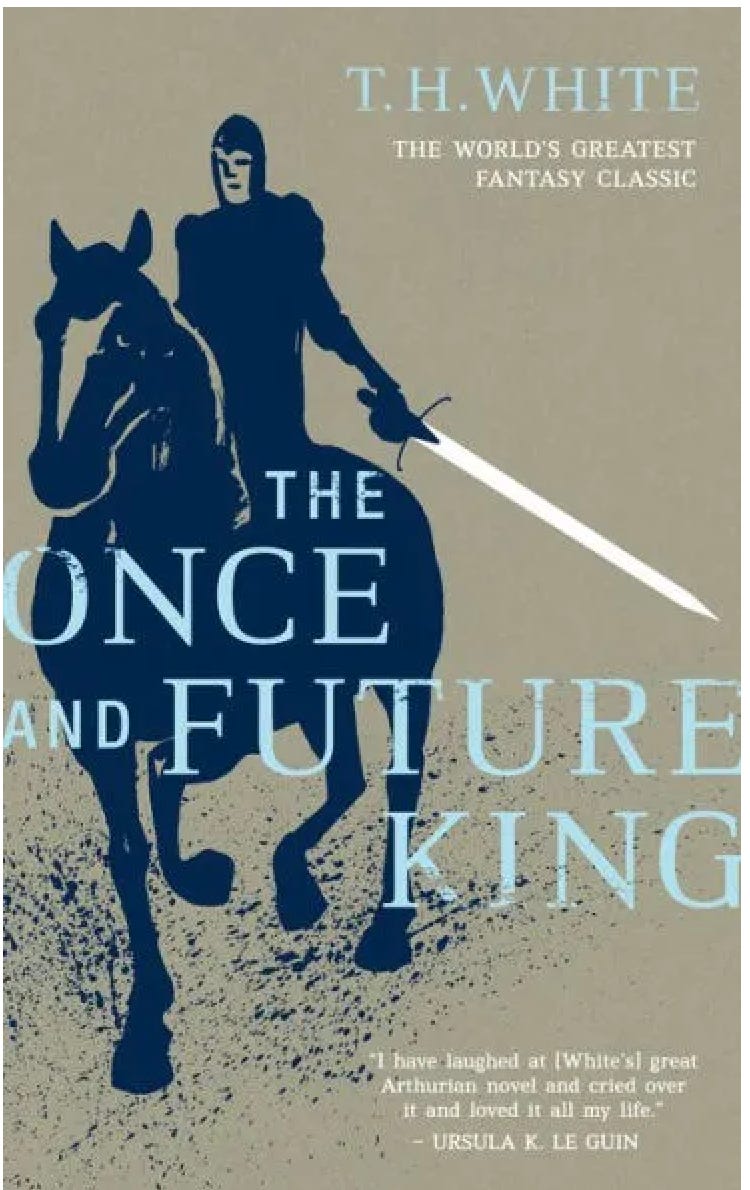
The Once and Future King by T.H. White.

Today, I’m very excited to bring you Robin Reardon.
In her newsletter, the aptly named Robin Reardon Writes, Robin writes multi-layered stories about people whose destinies are not determined solely by their sexual orientation or gender identity.
Today, Robin shares with us the book that made her — The Once and Future King. Enjoy!
My husband is a rocket scientist. All right, that’s not his title, but it’s close. He’s brilliant, and generous, and multi-faceted (for example, he composes music when his mind isn’t busy with abstract mathematics). Friends see us as very much alike; “two peas in a pod” was one comment.
Even so, he says he can’t always tell when a casual comment of mine is intended to be facetious, or sarcastic, or even just funny. I know why he tells me this, and the reason for it delineates the biggest difference between us. It’s not that he has no sense of humor, or that he can’t crack a joke himself (though he is inordinately fond of puns). No. It’s that as a scientist, he’s literal; as an author, I love metaphors and often speak in them.
I was a teenager the first time I read The Once And Future King. On the surface, it’s a story of Camelot: of a noble king (Arthur), the beautiful queen who loves him (Guinevere), and the self-effacing, powerful soldier who worships him (Sir Lancelot). And for a good portion of the book, it seems like a story you might read to children. I particularly loved the sections where Merlin the magician transforms Wart, the boy king who will be Arthur, into different animals, so that he learns what it means to be human.
Below the surface, however, in ways that didn’t always register as I was actively reading, are life lessons that have powerfully influenced my own writing.
Learning what it means to be human is also to learn what it is not to be human. Take the ant. Wart learns that ants have no imagination. Everything is either “done” or “not done.” Thus limited, ants cannot lie.
By extension, this same lesson shows what it is to be one human and not another. Consider the concept of character development, and in particular understanding our own character. When I compare my thoughts and beliefs to those of someone else, my own become clearer. And how would I know how many of my own conclusions about life are based on my personal assumptions until I encounter someone whose assumptions—and, perhaps, conclusions— are different?
Even when the conclusions are the same, they might be arrived at from different assumptions. And sometimes those assumptions are wrong. Take, for example, a conversation I had with someone I’ll call Jim. When it came to human rights in general and gay rights in particular, we agreed that it was none of our business what consenting adults do for intimacy. He said, “It’s not my business if someone chooses to be gay.” I replied, “You think it’s a choice? No; in fact, the National Academy of Science released a study in 2005 showing that it’s impossible for a gay man to have a physiological, sexual attraction to a woman. And hundreds of animal species have reliable percentages of their populations that are homosexual, and more species join the list every year.” Jim’s jaw dropped. He had reached the same conclusion I had, but his assumption was flawed.
This comparison of assumptions, conclusions, and motivations can be tricky. But unlike in real life, fiction is where we can explore a character’s intimate feelings and fears without invading their life or exposing them to scrutiny (with the possible exception of the author). We can dig into fictional characters in many ways that represent but don’t compromise the lives of actual individuals. We can expose their innermost truths as ruthlessly as serves our purpose.
When Merlin describes how the various creatures come before God and ask for specific characteristics (teeth, claws, superior hearing, camouflage, etc.), the last creature, Human, says (paraphrasing): “I ask for nothing. I am perfect as you made me.”
Perfect as you made me. This has been a defining motif throughout my writing. Not that any of us is perfect. Rather, the lesson we must learn is to be true to who we are. As another, more famous author put it: “To thine own self be true.”
White also calls upon another deep experience, described long ago in the frustrations of Tantalus, eternally reaching for fruit overhead that rises too high when he reaches for it, bending for water that recedes too far for him to drink. I see a certain parallel between this frustration and the way White contrasts the Questing Beast and the Holy Grail—one comedic and earthly, one celestial and sacred—both retaining their meaning only as long as they are unattainable. What rich, fertile ground for authors! Unlike Tantalus, my characters often manage to reach what it is they hunger for. It’s just not always what they thought they wanted.
Not all is perfect in Camelot, for White’s tale is also a story of betrayal, of self-delusion and false dreams, and of what happens when we draw lines between what’s yours and mine, between what you are and I am, and when we isolate ourselves from each other by any of the various means at our disposal.
It’s a story of what happens to love when we try to divide it.
I’ve read this book only twice. So far. I should read it again, to see what I missed. For now, it’s enough that its lessons find their way into my mind, into my heart, into my writing, and sometimes into the metaphors my husband doesn’t perceive. This book has become a lodestone for my work, both in terms of character development and in terms of the richness of a plot.
Before I wrote my first novel, I knew I wanted my characters to be real people, faced with the types of problems real people face, with outcomes as surprising as they are predictable. What a wonderful guide The Once and Future King has been.

P.S. For more ways of getting your writing in front of new readers, consider becoming a paying subscriber today.
 | A guest post by
|
Thank you so much, M.E. Rothwell, for providing this platform for writers. And thanks, especially, for posting mine! 😊