

Owning the Flow
The Mill on the Floss by George Eliot

Salutation, bibliophiles.
Today, I’m very excited to bring you Kameron Sanzo.
Kameron writes Electrotonic Letters, where she shares semi-regular letters and tidbits on the history of energy, from nineteenth-century thermodynamics to contemporary work culture and chronic illness.
Here she shares the book that made her — The Mill on the Floss by George Eliot. Enjoy!
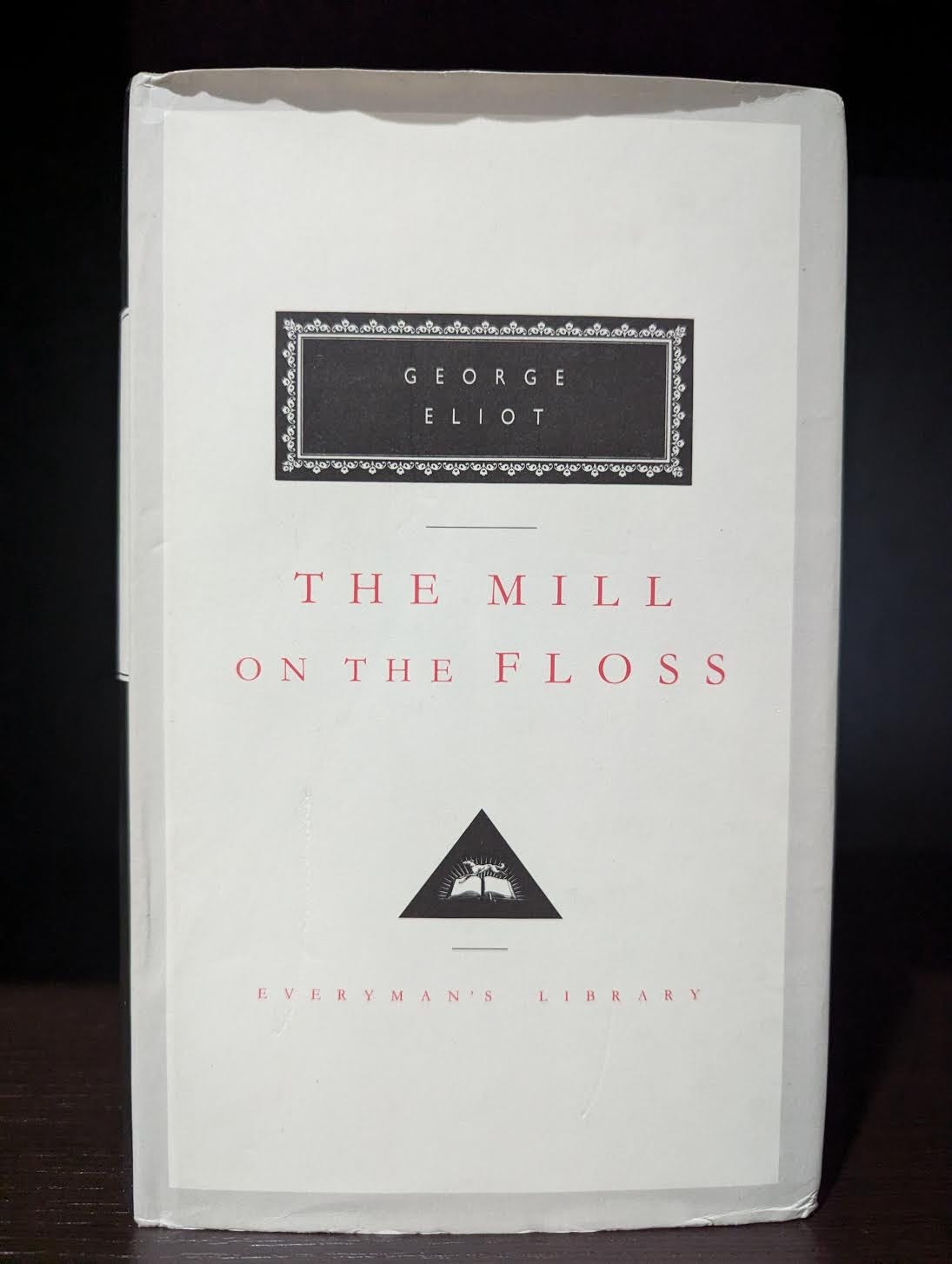
If you’ve ever read something and felt like it was already part of you, like the text summoned a side of yourself you needed to explore and make peace with, then you understand how I feel about George Eliot’s The Mill on the Floss.
That’s not a conclusion I reach often when I read Victorian novels, and I read them all the time. As a Victorianist, it is literally my job. I am fascinated by the Victorians and how they’ve influenced our grand narratives and large-scale cultural mythologies. But the Victorians horrify me for the same reason. I study their expansion-driven vision of progress and boundless economic growth, their shameless white supremacy and euro-centrism, and I trace out imperialistic values in the co-constitution of literature and Victorian science. So, I approach the nineteenth century with informed and somewhat detached enthusiasm. I know there will be thorns when I get into those research weeds.
As such, I don’t believe I would ever “feel very Esther Summerson” or “vibe with Jane Eyre” or “come up Mina Harker today.” There are too many degrees of affective separation between myself and those characters. But it’s a bit different with George Eliot’s novels. I consider The Mill on the Floss the book that made me. I’ve incorporated it into my professional life and my research, but it also fills a space for me psychically and affectively.
I adore Maggie Tulliver, George Eliot’s flawed, emotionally intense heroine, whose adolescent attempts at self-denial and asceticism are performed so passionately that they lose their intentions of humility and self-effacement. I love this character who lives in and was written during a period of male-coded emotional regulation and willful self-command, and who struggles to govern her own passions and intensities into productive outlets. Though we aren’t literal Victorians, I often feel that Maggie Tulliver is the heroine we need now, when we are surrounded by cultural messages to produce and work more, to either stuff our feelings down or channel them into goals. Maggie’s spectacular failure to perform self-regulatory productivity values feels refreshing to me in this moment.
But why does Maggie throw herself into exaggerated asceticism? This is how she responds to the novel’s central conflict: the loss of her family’s riparian grist mill and the fuzziness of litigating control of shared waterways.
When Individualism Meets Flow
The Mill on the Floss was published in 1860, but George Eliot looks backward in this novel, setting the narrative in the 1820s. This was a time when steam power assisted water-bound mills and factories, but before steam released industry from requiring waterpower. The plot centers the fictional rivers Floss and Ripple; and the story chronicles their periodic flooding, conflict over control and ownership of waterpower, and the productive use of waterpower in riparian mills.
I know, I know. Litigation over early nineteenth-century riparian doctrine sounds riveting. But, actually, it is, and you’ll have to trust me. Think about it: conflict over water ownership opens up some meaty ontological questions. How do you own water along a river, anyway, and what part of water are we referring to when we talk about ownership? The flow? The whole river? A droplet on my property at this moment, right now? What happens to that same droplet when it flows past my property line and enters my neighbor’s? Water infrastructures like mills, and the flow of water that operates them, create new zones of contact, movement, and disruption that combine the individualism of property ownership with a sense of wholeness only in aggregate. We refer to the right to water flow. We do not commonly speak of owning this or that water droplet.
Questions of water ownership get crunchier when you add riparian equipment to the mix. Industrial waterpower relied on the caprices of weather, in addition to the unstable foundations of British riparian doctrine, which attempted to parse out laws of right to waterpower. Because water moves, we can channel it, divert it, dam it, or dissipate it; and because a riparian mill requires a healthy water flow, anyone who dams or diverts that flow upstream will disrupt the mill’s output.
Eliot’s narrator in The Mill on the Floss follows Mr. Tulliver, a miller whose upstream neighbor plans to build an irrigation system. As the Tulliver family deals with the potential crisis of waterpower and personal loss, each character bears out their reality of literal water conflict in the affective dimensions of water. That is, George Eliot’s figurative and literal uses of flow in The Mill converge on questions of ownership and control: mastering the flow and surges of water, and mastering the flow and surges of emotions.
Water and Feelings are Old Bedfellows
In the Mill on the Floss, water flow is a figurative stand-in for the language of emotions. Water is life-giving and cleansing. But water also destroys. Natural disasters remind us that a single flood can efface the imprint of generations on a landscape. We can make water perform work to our advantage, so what might have been a dangerous or wasted flow is now a tool of capital, a source of enrichment and growth. The Victorians were quite a bit like us: they wanted to extract value from every resource available to them. It would be a shame, then, to let a river’s flow go to waste when you can harness that energy and make it work for you. Victorian self-help culture affixed these notions of industrial work to the virtues of bootstrapping. Books like Samuel Smiles’s aptly titled Self-Help (1859) opined that discipline, self-denial, and steady work were virtues of social mobility. Water flow underpinned such language. The energy of the will, according to Smiles, was a flow that exists within us. And, like water, we can direct that flow towards productive work, or we can let it dissipate without benefiting us.
George Eliot, however, resists the narrow coupling of emotional economy and self-help. Instead, the novel takes great pains in setting its heroine apart from those described as “narrow,” or characters associated with a traditional industrial imaginary. Maggie copes with her father’s water conflict by feeling and expressing, often at cross-purposes with her relatives’ desires. The Mill collapses the language of Maggie’s emotions into the flow of water. Maggie is marked by her powers of emotional excess, where even feelings leave flood marks. Such marks are simultaneously records of inner conflict and omens of the energies that might surface in the future.
For better or worse, Maggie possesses an emotional intensity that her relatives do not. Whatever she feels in this novel, she allows herself to be swept up in it. As a child, for example, Maggie spends a morning grinding the head of her doll against the attic floor as punishment for her own misfortunes, until she suddenly rushes downstairs to sing and dance in celebration of her brother Tom’s coming home from school. Later, when Tom and Maggie are young adults, he accuses her of inconsistency, that she is “always in extremes,” and has “no judgment and self-command.”
These latter regulatory traits, the channeling of extremes towards productive work and social mobility, and particularly what Eliot calls “narrowness,” likewise connect Tom to the Floss. Tom aligns with the language of water management and commerce, as opposed to the “strong tide[s]” which characterize his sister. Tom may be stubborn and single-minded, but that willful inflexibility equips him with a kind of industrial intelligence, which Eliot encourages us to think of with sympathy, despite its limitations and blinders. Tom aligns with the Smilesian bootstrapping hero, the young man who gets his act together, masters his emotions, and - like a good industrial machine - channels his energy to work productively for him.
Today, we’d say Tom had really mastered the grind. And this is Tom’s superpower. He needs to do this to help his family. But what he doesn’t understand, and what Maggie reminds us, is that Tom’s approach is both gendered and limited. His experience of and reaction to the Tulliver family’s trauma is not the only viable option.
Sometimes You Just Need to Feel Big Feelings
Here’s what’s so special about this novel: Whatever affective economy Eliot builds into The Mill on the Floss, it operates, like water, beyond the narrowness of productivity. While directing your will to work for you is great, like channeling water flow to turn a water wheel in a riparian mill, affects and water are still subject to larger forces beyond individual control. The mill, for one, is imbricated in, and subject to, the river and weather patterns. Sometimes there are storms. Sometimes the river floods. You can’t control a flow when natural forces overwhelm and even threaten the entire riparian landscape.
Likewise, sometimes it is inadvisable, and perhaps even impossible, to control, divert, and channel affective intensities that need to be spent, vented, or nursed. Stubborn individualism fractures when forced into the collective logic of water flow. And no man is an emotional island. Humans depend on others. Affects are often rooted in traumas, identity politics, and sometimes the land itself.
We, like the Victorians, live in a world that demands we extract maximum value from our labor and even from our emotions. Each time I read The Mill, I sympathize with Tom, but I feel with Maggie. Affective impulses are not demonized by George Eliot as wasteful energies to be buried or restricted. And I feel cautioned, with each reread, against the limitations of confining the mind, as with the forces of nature, to a limited range of experience.
P.S. For more ways of getting your writing in front of new readers, consider becoming a paying subscriber today.
 | A guest post by
|
I've been meaning to read more Victorian books once I can finally overcome my favourite book (Jane Eyre) and this would be a nice next step. I've never heard of George Eliot before but that's why we're here to learn, aren't we? Thank you for sharing and I look forward to reading The Mill on the Floss (if I can find it that is).