

A Window of a Book
A Thousand Splendid Suns by Khaled Hosseini

Salutations, bibliophiles.
Today, I’m very excited to bring you Paige Gardner.
Paige writes WANTED: Kindred Spirits , where she tries to make sense of this messy and beautiful world.
Here, Paige shares the book that made her — A Thousand Splendid Suns by Khaled Hosseini. Enjoy!
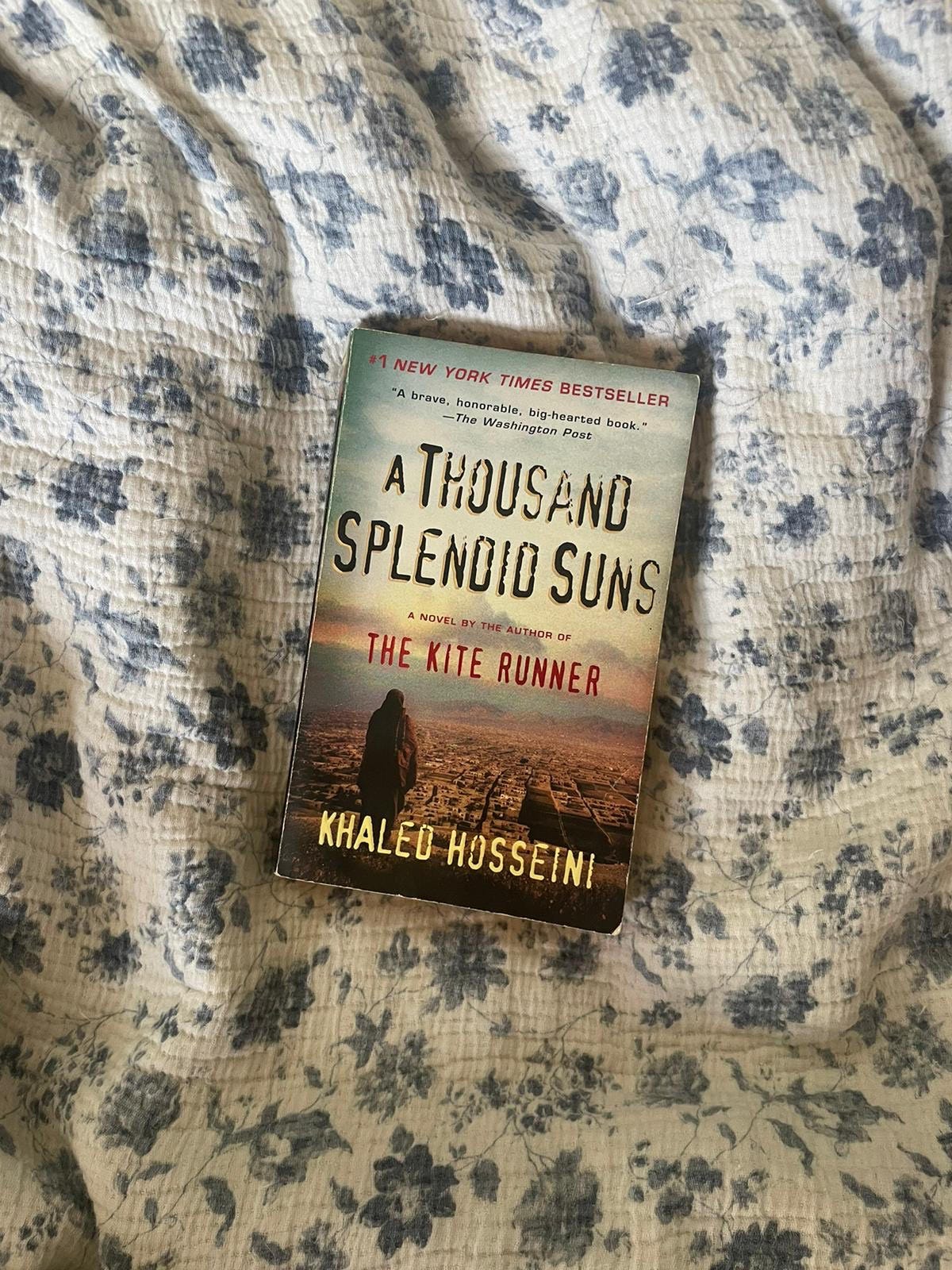
Dear Khaled Hosseini:
Because of you, my life will never be the same.
Prior to reading your second novel, A Thousand Splendid Suns, I was like most other 14-year-olds: convinced that the world revolved around me. I had never thought of the greater world and, having grown up in a small town in the United States, I was surrounded by people who looked like me, spoke like me, ate like me, and experienced the world like me. Copy. Paste.
But you, Mr. Hosseini, you transported me, taking me on a four-decade long journey through Afghanistan. There, I could feel the warmth of the mug that holds the cup of chai; I could see the last of the season’s fireflies sparkling in the backyards; I could hear the gunfire crackling in the hills. So now, it’s my turn. Let me paint a scene for you — the way you’ve painted so many scenes in your novel that now, fifteen years later, I can still picture everything as vividly as the day I first read it. Let me take you back to 2009, to a little suburban town outside of Pittsburgh, Pennsylvania…
My mother and I sat in the car together on a warm summer day, riding through the quiet streets of our neighborhood. I gazed out the open window, my mind drifting. We passed by green lawns and enormous trees swaying in the soft breeze. In the distance was the ever-present soundtrack of my life: hums of lawnmowers, bouncing of basketballs, splashes of backyard pools. My mother chirped from the driver seat, going on and on and on about some book she had just finished reading. “I know it’s different from what you normally read, but I think you should read it,” she said. “It’s about two women in Afghanistan.”
I rolled my eyes, leaning further out the window. “I don’t even know where Afghanistan is,” I mumbled.
A moment of blissful silence inside the car.
Until: “Exactly. That’s why you should read it.”
Ugh. She wouldn’t let up. Once we arrived back home, she lent me her copy. My mother usually never recommended books to me, so that alone inspired me to crack it open and take a peek. I was sure that I’d read the first few pages before moving on to the next, better book.
But there would be no “next, better book.” A Thousand Splendid Suns would grip me from the very first sentence — “Mariam was five years old the first time she heard the word harami” — and it would not let me go for the rest of the story. It would not let me go for the rest of my life.
There are images from this story that are burned into my brain: fragments of broken molars, drops of blood on a rug, a picture of the Golden Gate bridge printed on a t-shirt. The characters are a constant presence in my life, as real as any family or friends. I cried for them; I celebrated alongside them. I returned to that novel throughout high school and college, reading and re-reading. I suddenly became my mother, pitching the novel to every person in my life.
You’ve surely heard these things before, Mr. Hosseini. I know I’m not the first person to tell you this, and I won’t be the last. My friend, a former English teacher, recently shared with me that we need books to act as mirrors and windows. Mirrors show us ourselves, a true gift. Even when mirrors reveal parts of us we do not wish to see, the reflection staring back at us allows growth. Up until I received your novel, my reading experiences served as mirrors.
A Thousand Splendid Suns was a window. The biggest, brightest, most beautiful window.
That window explores the lives of two women, Mariam and Laila, against the backdrop of war and political turmoil in their home country of Afghanistan. At first, I was confused; they seemingly had no connection to one another, having been born in two different decades to two different families. But as you take us further into their lives, tragedy forces their separate narratives to merge into one. Mariam and Laila’s relationship dynamic was brand new to me. It encouraged me to ask questions I never considered: Can we choose our own families? Are people born good or evil, or are they products of their environment? Can wicked acts be done for love — and does that make them acceptable?
Despite being published in 2007, your book stays staggeringly relevant. Whenever I read about the wars that occur in various countries today, I immediately think of Mariam and Laila — civilians who are caught in the crossfire. Innocent people whose lives change overnight. I think, always, of the scene when Laila and her father sit at the kitchen table, listening in tense silence to the whistling of the rockets descending upon Kabul:
“The whistling. Then the blast, blissfully elsewhere, followed by an expulsion of breath and the knowledge that they had been spared for now while somewhere else, amid cries and choking clouds of smoke, there was a scrambling, a bare-handed frenzy of digging, of pulling from the debris, what remained of a sister, a brother, a grandchild.” (p. 173)
Nothing brings home the impact of war and the plight of refugees like Laila’s father Babi talking about making the difficult decision to leave his home:
“I went to school here, got my first job here, became a father in this town. It’s strange to think that I’ll be sleeping beneath another city’s skies soon.” (p. 172)
Reading those words for the first time at age 14, I felt everything inside shifting. Tears streamed down my face as I placed the book down on the bed, cuddling up to my dog and hurrying to find the safe embrace of my mother. I never considered what it would be like to have to forcibly leave the only home I’d ever known. For a brief moment in time, I was living Babi’s life. I mourned with him, and I became furious at the injustice.
Despite the darkness that hides between the pages of A Thousand Splendid Suns, you never fail to show us the light. Often it comes in the form of a small interaction or the banter between beloved characters. One of my absolute favorite parts of the novel is this simple conversation between Mariam and Laila:
“The Chinese say it’s better to be deprived of food for three days than tea for one.”
Mariam gave a half smile. “It’s a good saying.”
“It is.”
“But I can’t stay long.”
“One cup.”
They sat on folding chairs outside and ate halwa with their fingers from a common bowl. They had a second cup, and when Laila asked her if she wanted a third Mariam said she did. (p. 223)
Here are two women, sitting side by side, sipping chai. They may have grown up in a country 7,500 miles from my own, but perhaps we aren’t so different after all.
Your window of a book introduced me to the world, opening me up to the pain and sorrow and joy and love that all people feel. After this awareness, everything changed. The small bubble I grew up in popped — thank God. I took a real interest in learning about other cultures, which led me to major in sociology in college, which led me to study abroad in South Korea, which led me to volunteer to teach English to speakers of other languages (ESOL), which led me to get a master’s degree in teaching ESOL, which has led me to teach and travel all over the world. My younger self could never envision this life for me, because she didn’t have the right windows to look through.
So my butterfly effect, the moment that changed my life, was my mother recommending A Thousand Splendid Suns to the self-absorbed, sheltered version of my teenage self. And now, fifteen years later, there are moments in my ESOL classes when I talk with one of my adult students from Afghanistan, and I listen to her speak about her life, of all she’s endured, and my heart squeezes as I think, You. You are so brave. You are Mariam and Laila in the flesh. You are the reason I am here.
Paige
P.S. For more ways of getting your writing in front of new readers, consider becoming a paying subscriber today.
 | A guest post by
|
Lovely Paige.. I’m so glad I ended up here today to enjoy your generous, impactful story. I’m headed to the library. Though I have read The Kite Runner, I haven’t yet read A Thousand Splendid Suns or And The Mountains Echoed… 🫂
Paige, this gave me such joy to read, your thoughts and feelings are a mirror to my own. Thank you and please take care of your wonderful spirit, don’t let this scary, often cruel world change you.
I too have been trying see through the windows, reading authors who open my eyes to other ways of living, Isabel Allende and Elif Shafak are amazing and I will read A Thousand Splendid Suns very soon.